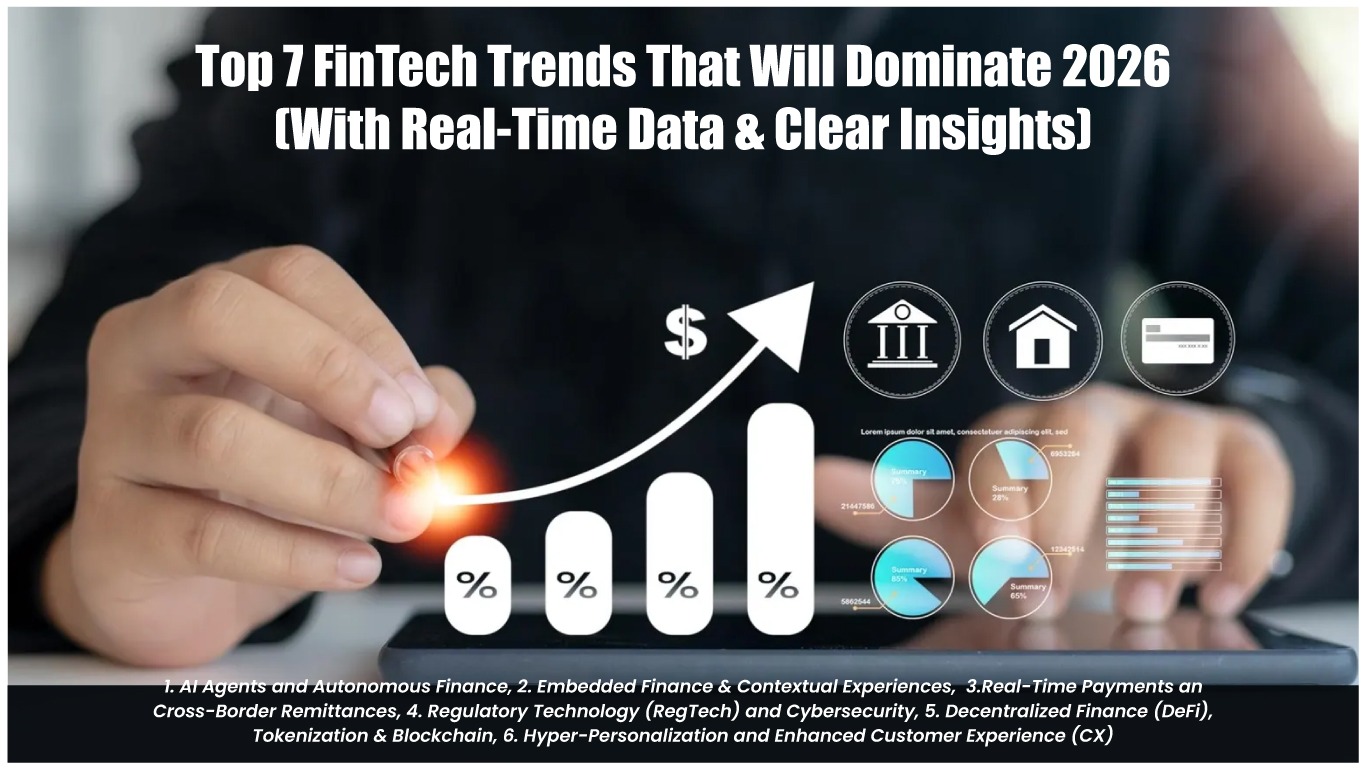
Top 7 FinTech Trends That Will Dominate 2026 With Real Time Data and Clear Insights
FinTech is no longer a future concept. It is today’s reality — and by 2026, it will become the invisible backbone powering almost every digital experience we interact with. Whether it’s instant payments, personal finance apps, digital lending, or AI-driven banking, financial technology is now everywhere.
Global numbers also show that fintech adoption is accelerating. The worldwide fintech market is expected to grow from around USD 209 billion in 2024 to almost USD 1.58 trillion by 2033, growing at more than 25% CAGR. Real-time payments, AI-led decisioning, programmable money, and tokenized assets are moving from buzzwords to billion-dollar industries.
This blog covers the Top 7 FinTech Trends that will dominate 2026, backed with fresh data, examples, and a forward-looking analysis.
1. Embedded Finance Will Become the Default Layer
What is embedded finance?
It is the integration of financial services directly inside non-financial applications. Examples:
- Instant credit inside an e-commerce checkout
- Insurance built into a travel booking
- Loans inside accounting software
- Wallets and savings inside food delivery apps
Why it will explode in 2026
- The global embedded finance market was valued at nearly USD 100 billion in 2023 and is projected to reach over USD 250 billion by 2029.
- Broader estimates show embedded finance could generate USD 7 trillion+ in value by 2030.
- In India alone, embedded finance revenues may grow from USD 21 billion (2024) to USD 33–34 billion by 2030.
Embedded finance is shifting from “a new trend” to “the default customer experience.” In 2026 you will see:
- Every marketplace offering credit, insurance, and BNPL
- SaaS platforms embedding banking-as-a-service
- Logistics platforms embedding freight financing
- Healthcare apps embedding EMI and medical loans
If you’re building any kind of digital product — from B2B to consumer apps — embedded finance will become a mandatory moat.
2. Real-Time Payments (UPI-Like Systems) Will Become Global
The world is adopting instant payments at a record pace. India’s UPI model has inspired dozens of countries.
Real-time payment data:
- UPI processed 172+ billion transactions in 2024, up 46% from 2023.
- In 2025, UPI crossed 20 billion transactions in a single month for the first time.
- Globally, real-time payment volumes touched 266 billion transactions in 2023, growing over 40% YoY.
- The real-time payment market was around USD 26 billion in 2024 and is expected to reach USD 116 billion by 2029.
What’s coming in 2026
- More countries rolling out UPI-like instant rails
- Cross-border instant payment corridors becoming common
- Instant payouts for gig workers, freelancers, creators, and SMEs
- 24x7 corporate and B2B payments replacing slow batch settlements
Businesses will redesign cash flow, refunds, vendor payments, and settlements around instant money movement.
3. AI & Generative AI Will Become the Brain of Financial Services
AI is no longer optional. Banks, NBFCs, and fintechs are integrating AI across every process.
The global banking sector crossed USD 5.5 trillion in revenue in 2024, with pressure mounting to cut costs and automate decision-making. AI is the fastest lever.
What AI will dominate in 2026
- AI-Based Underwriting
- Loans will be approved based on real-time cash-flow history, spending pattern, GST data, platform transactions, and not only bureau scores.
- Loans will be approved based on real-time cash-flow history, spending pattern, GST data, platform transactions, and not only bureau scores.
- Hyper-Personalized Financial Advice
- Apps will give custom money plans and real-time behavioural nudges.
- Apps will give custom money plans and real-time behavioural nudges.
- Fraud Detection & AML
- AI will detect subtle fraud signals within seconds, far beyond traditional rule engines.
- AI will detect subtle fraud signals within seconds, far beyond traditional rule engines.
- AI Copilots for Bankers & Analysts
- Summaries of risk reports, customer data, trading insights, portfolio analysis — all auto-generated.
- Summaries of risk reports, customer data, trading insights, portfolio analysis — all auto-generated.
- Customer Service Automation
- AI assistants will replace 70–80% of routine support tasks.
- AI assistants will replace 70–80% of routine support tasks.
Winning in 2026 will depend on who has:
- better and cleaner customer data
- better model governance
- more powerful AI pipelines
AI will not just assist financial services — it will run them.
4. Open Banking Will Evolve Into Open Finance
Open banking originally allowed third-party apps to access bank data (with customer consent). Now it is expanding into open finance, where everything becomes API-accessible:
- Bank accounts
- Mutual funds & Demat
- Loans
- Insurance
- Pension accounts
- Credit cards
- BNPL
- Payroll data
Market Growth
- The open banking market was around USD 31 billion in 2024.
- It is projected to hit USD 135 billion by 2030, growing more than 27% annually.
What 2026 will bring
- Unified dashboards where users can see all financial products in one app
- Cash-flow based lending powered by API connectivity
- Faster wealth-tech and insure-tech innovation
- Wider rollout of Account Aggregator-style systems
- Better competition among banks and fintechs due to data portability
Open Finance will lead to a new era where consumers truly own their financial data and choose where to share it.
5. CBDCs (Digital Currencies) & Programmable Money Will Go Mainstream
Central Bank Digital Currencies (CBDCs) are gaining serious momentum.
Key developments:
- Over 90% of central banks worldwide are actively working on CBDCs.
- More than 10 countries already have live CBDCs, and over 50+ are running pilots.
- India’s Digital Rupee has become the second-largest CBDC pilot in the world.
- Digital Rupee in circulation increased from ₹2.3 billion (2024) to ₹10.1 billion (2025) — a 300%+ jump.
What 2026 will look like
- CBDC usage for government payments (subsidies, welfare, tax refunds)
- CBDC-based cross-border settlement
- Offline CBDC wallet for remote areas
- Programmable money — where funds can be conditional
- Faster treasury operations for businesses
CBDCs will not replace cash entirely, but they will transform settlement, transparency, and government financial systems.
6. Tokenization of Real-World Assets (RWAs) Will Explode
Tokenization turns traditional assets like bonds, gold, funds, real estate, invoices, and treasury bills into digital tokens on blockchain rails.
This is not crypto speculation — this is regulated finance moving on-chain.
Market outlook:
- Tokenized RWAs could reach USD 1.5–2 trillion by 2030 (minimum estimate).
- Optimistic models project up to USD 16 trillion in tokenized assets by 2030.
- Tokenized fund assets may grow from USD 90 billion to over USD 700 billion by 2030.
- Major asset managers have already started issuing tokenized money-market funds.
What happens by 2026
- Retail investors will buy tokenized treasury bills, gold, and bond funds from apps and wallets
- Real estate and private credit will be sold in fractional tokenized formats
- 24x7 trading + instant settlement becomes possible
- Institutional finance (TradFi) starts moving to blockchain rails
- More fintech–asset management partnerships emerge for tokenized products
Tokenization will make investments safer, faster, and more liquid. It also opens trillion-dollar opportunities for startups that build tokenized marketplaces, custody, and settlement tools.
7. RegTech, Digital Identity & Fraud Prevention Will Become Essential
As finance moves online, fraud moves even faster. Governments, central banks, and financial institutions are enforcing stricter rules.
The FinTech-as-a-Service market alone was around USD 408 billion (2024) and may cross USD 900 billion by 2030. This means millions of embedded finance transactions — and thousands of new platforms offering financial services.
What 2026 will bring
- API-led KYC & KYB services with instant verification
- Reusable digital identity wallets
- Behavioural biometrics (typing pattern, device movement, swipe habit)
- AI-based fraud engines
- Continuous, real-time AML monitoring instead of one-time KYC
- Global compliance layers for multi-country fintechs
RegTech in 2026 will not be a support function — it will be a mandatory engine for scale and trust.
Preparing for the FinTech Landscape of 2026
To stay ahead in the next wave of financial innovation:
1. Treat finance as a layer, not a product
Any digital platform — logistics, healthcare, ecommerce, SaaS — will embed payments, credit, or insurance in 2026.
2. Build for instant payments
Assume instant payouts, instant refunds, real-time settlements, and 24×7 money movement.
3. Invest in AI and data
Data cleanliness, labeling, and governance will matter more than the models themselves.
4. Embrace Open Finance
APIs will unlock rapid innovation across lending, wealth, insurance, and payments.
5. Understand CBDCs and tokenization
They will change corporate finance, treasury ops, and settlement layers.
6. Strengthen RegTech early
Fraud, onboarding, and compliance will decide whether platforms scale or fail.
Conclusion
2026 will be the year when financial services fully merge with daily digital experiences. Money will move faster, credit will be more personalized, identity will be reusable, and investments will be tokenized. The FinTech wave is not only transforming banks but also empowering startups, marketplaces, and creators.